
Rome Conference Advances European Cooperation on More Effective Anti-Corruption Agencies
More than 200 participants joined the ANAC-IACA event, which combined high-level debate with two days of technical discussions on measuring institutional effectiveness
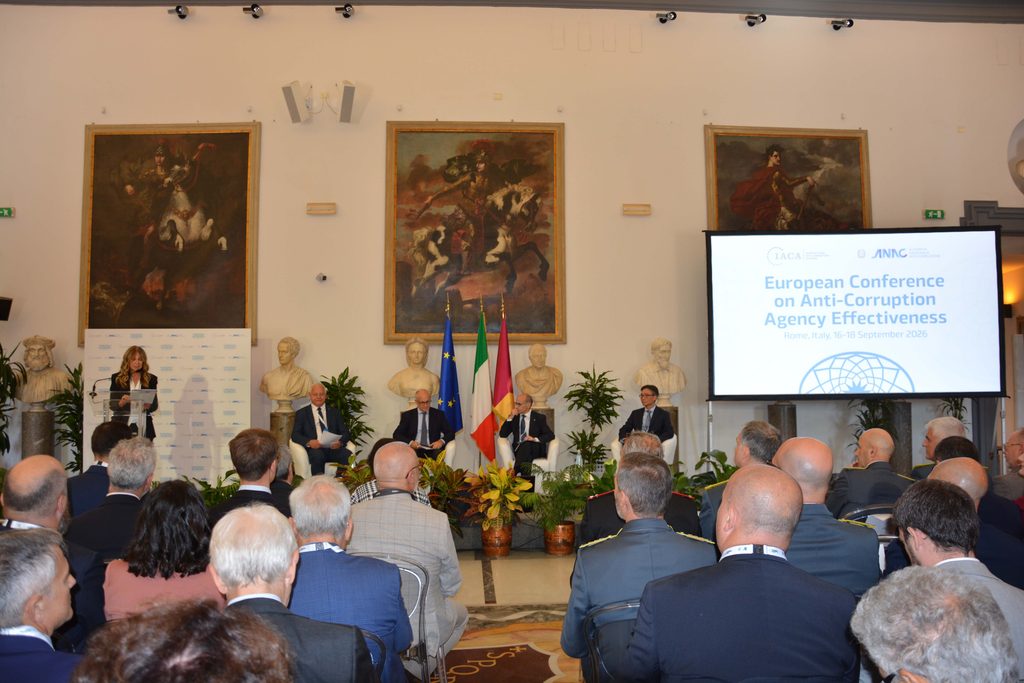
Rome, 18 September 2026 – From 16 to 18 September, Rome hosted the European Conference on Measuring the Effectiveness of Anti-Corruption Agencies, bringing together anti-corruption authorities, European and international organisations, national statistical offices and leading experts from across Europe.
Organised by the Italian National Anti-Corruption Authority (ANAC) and the International Anti-Corruption Academy (IACA), the three-day event opened with a high-level public conference in the Sala della Protomoteca at the Campidoglio, attended by more than 200 participants. It was followed by a technical expert meeting dedicated to European Anti-Corruption Agencies (ACAs).
The opening ceremony included institutional contributions from European and international representatives. In a video message, Michael McGrath, European Commissioner for Democracy, Justice, the Rule of Law and Consumer Protection, reaffirmed the European Union’s commitment to strengthening integrity systems and supporting independent and effective anti-corruption institutions.
The conference addressed some of the most significant developments shaping Europe’s anti-corruption agenda, including the proposed EU Anti-Corruption Directive, preparations for the first European Anti-Corruption Strategy, and national approaches to prevention, enforcement and institutional performance.
A central focus was IACA’s new methodology for measuring the effectiveness of Anti-Corruption Agencies. Developed within its Global Programme on Measuring Corruption, the methodology was piloted in 2025 with the participation of 50 agencies worldwide. IACA also presented its new digital platform for collecting and analysing data on ACA performance, as part of its objective to involve 100 agencies in the initiative in 2026.
During the expert sessions, representatives of Anti-Corruption Agencies examined regional and global trends, exchanged operational experience and explored closer cooperation with national statistical offices to improve the collection and use of evidence. Discussions highlighted the importance of developing indicators that reflect the different mandates and institutional contexts in which ACAs operate.
The final sessions looked ahead to emerging challenges for anti-corruption authorities, with a particular focus on political finance transparency and the use of information technology and artificial intelligence to detect corruption.
By combining high-level policy debate with practical exchanges among institutions, the Rome conference strengthened European cooperation and contributed to a shared objective: building more effective, evidence-based and resilient anti-corruption systems across the continent.